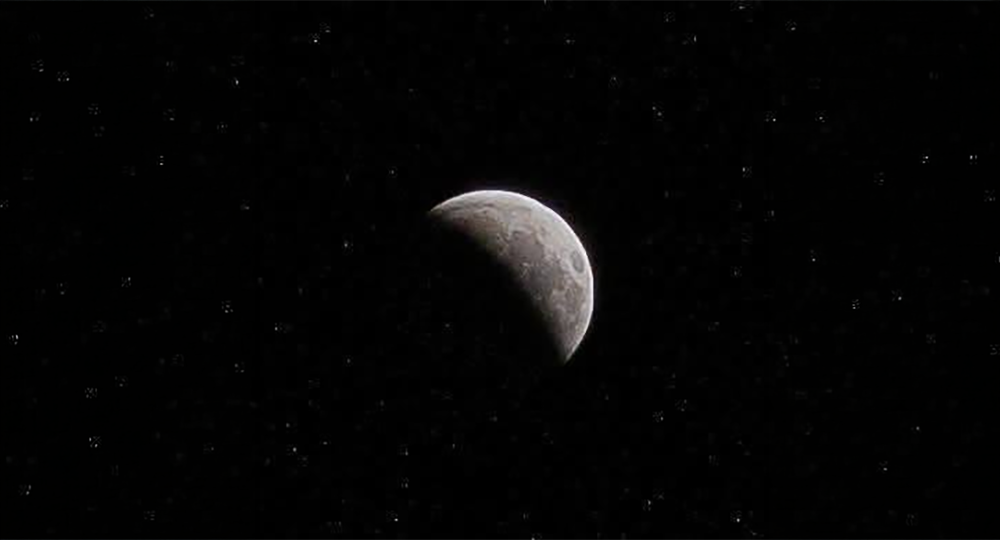

The Moon in Earth’s Shadow: A Celestial Show Above Ottawa
On the night of August 27–28, Ottawa residents witnessed one of the most impressive astronomical events of 2026—a deep partial lunar eclipse.
The first subtle changes began at approximately 9:23 p.m. At 10:33 p.m., Earth’s dark inner shadow started moving across the lunar surface. The eclipse reached its maximum at 12:12 a.m., when approximately 96.3 percent of the Moon’s visible disk was inside Earth’s shadow. The partial phase ended at 1:51 a.m., while the entire event lasted about five hours and 38 minutes, according to NASA
A Meridian Press correspondent observed the eclipse in person. Before my eyes, the familiar bright Moon seemed to dissolve slowly into the night sky. The most striking moment came when only a narrow shining edge remained, while the shadowed portion acquired a subdued copper-red colour. The surroundings were remarkably quiet, and the slow movement of Earth’s shadow felt almost ceremonial.
A lunar eclipse occurs when Earth passes between the Sun and the Moon. This eclipse did not become total, however, because a small part of the lunar surface remained illuminated by direct sunlight.
The event belonged to Saros 138, a repeating series of eclipses. The previous eclipse in this series occurred in 2008, while the next is expected in 2044.