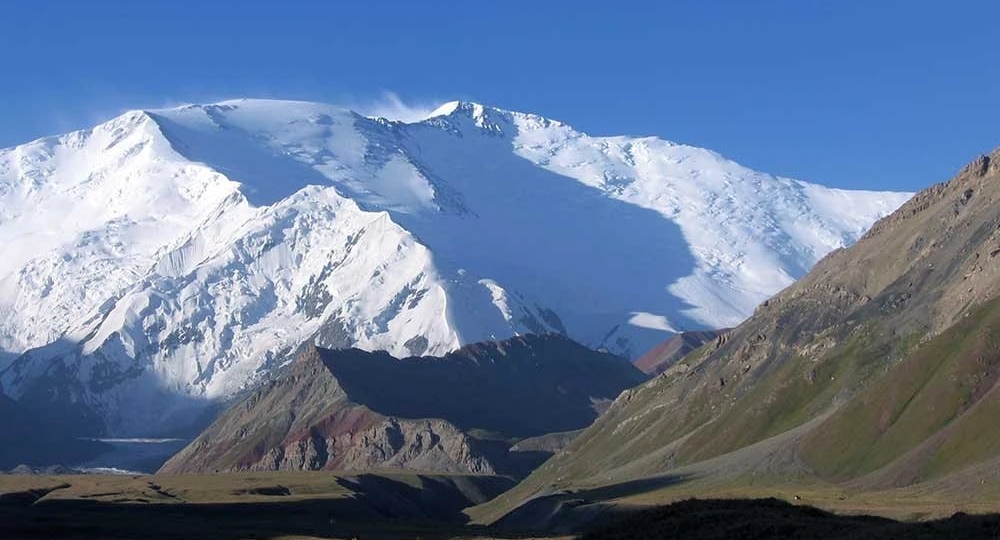

Grandeur Divided
The Pamirs rose.
The young mountain ranges stubbornly stretched upward, piercing the sky with the fangs of their seven-thousand-metre peaks.
Among them stood a giant, 7,134 metres high.
It had stood there for millions of years, never suspecting that one day people would divide it in two.
At the end of the nineteenth century, topographers of the Russian Empire arrived at the foot of the mountain in the Kokand Khanate.
They put the mountain on their maps and named it after the serving Governor-General of Turkestan—Kaufman Peak.
Kaufman himself had never explored the summit, nor had he ever climbed it.
The mountain remained silent.
The Governor-General died.
The empire fell...
New people arrived.
Wearing leather jackets.
In 1928, they solemnly announced that from then on, the mountain would bear the name of the leader of the world proletariat—Lenin Peak.
The mountain remained silent.
Armchair cartographers drew an administrative line across the ridge and the summit—the border between Soviet Kyrgyzstan and Tajikistan.
The mountain remained silent.
Six decades passed.
The enormous country fell apart, and the imaginary line on paper hardened into an international border.
On the southern side of the border, it was decided that the name of the revolutionary leader was alien to the new national pride and that the summit needed a new name.
In 2006, it was solemnly renamed after the great medieval physician and philosopher of Persian origin—Abu Ali ibn Sina, known as Avicenna.
But the decree extends only as far as the crest of the ridge.
The neighbours on the northern side looked at the summit, weighed everything up, and kept the old name.
Besides, in international mountaineering, Lenin Peak had long since become a recognizable brand.
And so the great mountain found itself divided in two by names.
From the south, it is a medieval Eastern sage.
From the north, a Russian revolutionary man of action.
In international reference books, two names for the very same summit live side by side.
The mountain is silent.
It is older than banners and every coat of arms.
It knows that true greatness needs no words and cannot be divided into parts.
The mountain is silent.
Author: Gleb Ivlev / G Un, 2026